 blog
blog
Bespoke Mirror Installation for Homes: A 2026 Guide
Table of Contents
- Bespoke Mirror Installation for Homes: What's Involved
- Measuring for a Custom Mirror: Getting the Dimensions Right
- Bespoke Bathroom Mirrors: Moisture, Safety and Style
- Full-Length Wall Mirrors: Making the Most of Your Space
- What a Mirror Installation Service Covers
- What Affects the Cost of Bespoke Mirror Installation
- Frequently Asked Questions
Last Updated: October 14, 2026
Bespoke Mirror Installation for Homes: What's Involved
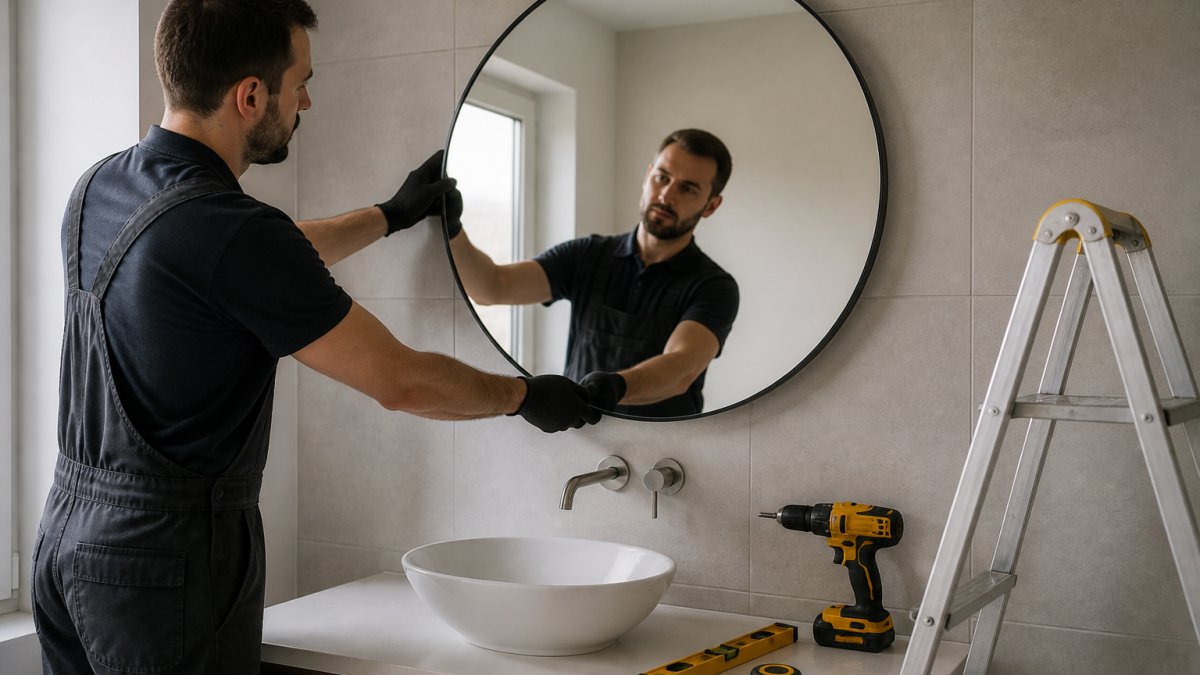
Bespoke mirror installation for homes is the process of measuring, cutting and fitting made-to-measure mirror glass to a specific wall, alcove or frame, rather than buying a standard size off a shelf. At JJ's Glass & Glazing, we handle that work from first measurement to final polish, so the mirror fits the space instead of the space being built around the mirror.
The difference shows up in the details. A made-to-measure mirror sits flush against the wall, reaches exactly where you want it to, and hides the raw edges behind polished glass.
Why Made-to-Measure Beats Off-the-Shelf
Standard mirrors come in a handful of sizes, and none of them were chosen with your wall in mind. You end up with gaps at the edges, a mirror that stops short of the ceiling, or one that crowds the door frame.
Made-to-measure mirrors solve that. Custom dimensions mean the glass reaches the full width of a chimney breast, slots between two wall lights, or runs floor to ceiling on a narrow landing. Cut-to-size mirrors also let you choose the shape: rectangular, arched, circular or a fully custom outline.
There's a practical benefit too. Off-the-shelf mirrors often use thinner glass and basic edge finishes. A bespoke mirror can be specified in the right mirror thickness, with polished edges and a silver mirror backing that resists tarnishing in humid rooms.
What to Expect From a Professional Fitting
A professional fitting starts with a site survey, not a tape measure held up by hand. We check the wall for level and plumb, look at what's behind the plasterboard, and confirm where the fixing points can safely go.
From there the process is straightforward:
- Measure the opening or wall area and record any obstructions
- Cut the mirror glass to size and polish the finished edges
- Prepare the wall and mark fixing positions
- Install using the correct fixing methods for the wall type
- Clean down and check alignment
Most domestic installations are completed in a single visit once the glass is cut. Supply and fit means you deal with one team from quote to finish.
Measuring for a Custom Mirror: Getting the Dimensions Right
Measuring for a custom mirror is where accuracy matters most, because glass cannot be adjusted once it's cut. A mirror that's 5mm too wide won't fit, and one that's 5mm too narrow leaves a visible gap.
Measure the width at three points: top, middle and bottom. Walls are rarely perfectly square, especially in older properties, so use the smallest measurement. Do the same for the height at the left, centre and right.
Then decide what the mirror is for:
- Above a basin: measure from the tap centre line outward, and leave clearance for the tap spout
- Full-length: measure from skirting to the height you want the glass to stop
- Feature wall: measure the full wall, then subtract a consistent margin on each side
If there's a socket, light fitting or tile trim in the way, note it before ordering. Cut-outs, drilled holes and notches can all be built into bespoke glass, but they need to be marked on the drawing first.
Bespoke Bathroom Mirrors: Moisture, Safety and Style
Bathroom mirrors need different glass to hallway or bedroom mirrors.
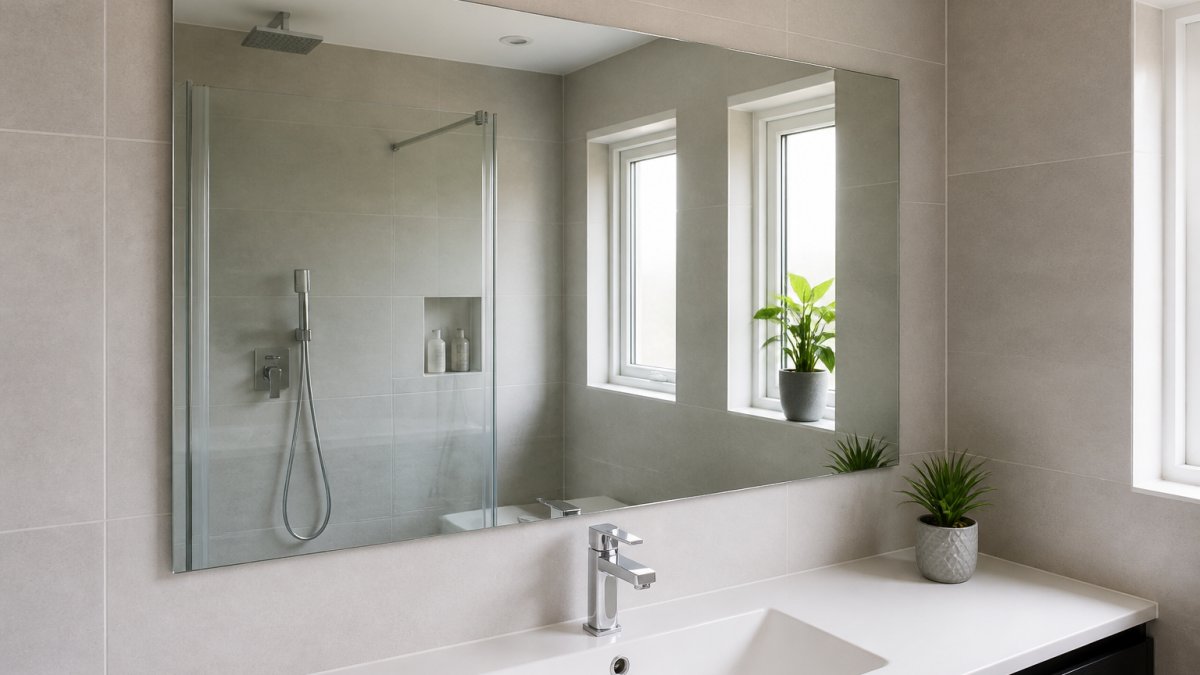
For bathrooms we specify mirror glass with a sealed backing and polished edges, which keeps moisture out of the silver layer.
Style-wise, bespoke bathroom mirrors work harder than standard ones. You can run the glass from the splashback up to the ceiling to make a small room feel taller, or cut a shape that follows an arched alcove.
One thing to watch: mirrors should never be fixed over a socket or directly above a hob. Position matters as much as the glass itself.
Full-Length Wall Mirrors: Making the Most of Your Space
Full-length wall mirrors do more than let you check an outfit. A large wall mirror bounces natural light into dark hallways, adds depth to narrow rooms, and turns an awkward blank wall into a feature wall.
The most common placements are:
- Hallways: a tall mirror at the end of a corridor doubles the sense of visual space
- Bedrooms: a full-length mirror on a wardrobe wall, either frameless or with a slim frame
- Staircases: a mirror following the stair angle, cut to fit the stringer line
- Gyms and home studios: larger panels that let you check form safely
Staircase mirrors are the trickiest of the four. The wall is rarely a simple rectangle, and the glass often needs a cut-out to clear a handrail or newel post. That's where professional measuring earns its keep.
Weight matters too. A large mirror is heavy, and it needs fixings rated for the load. We check what the wall is made of before deciding on the fixing method, because plasterboard alone won't hold a full-height panel.
What a Mirror Installation Service Covers
A mirror installation service covers everything from the first measurement to the final clean, including supply of the glass, cutting, edge polishing, wall preparation and fixing. You don't need to source the mirror separately and then find someone to fit it.
Here's what a typical job includes:
| Stage | What Happens | Who Does It |
|---|---|---|
| Site survey | Wall checked for level, plumb and suitable fixings | Installation team |
| Measuring | Dimensions taken at multiple points, obstructions noted | Installation team |
| Glass cutting | Mirror cut to size, edges polished, holes drilled | Workshop |
| Wall preparation | Surface cleaned, battens or adhesive specified | Installation team |
| Fitting | Mirror fixed, aligned and sealed | Installation team |
| Handover | Cleaned down, care advice given | Installation team |
Supply and fit keeps responsibility in one place. If a measurement is wrong, it's our problem to sort, not yours.
What Affects the Cost of Bespoke Mirror Installation
Pricing for bespoke mirror installation depends on several factors, and we quote each job individually rather than working from a fixed price list. That said, you should be able to walk into a quote conversation knowing roughly what drives the number up and what keeps it down.
The Factors That Move the Price
- Size and weight. Glass is priced by area, and handling cost rises with weight. A small bathroom mirror and a full-height hallway panel are different jobs even if the glass type is identical.
- Glass type. Standard mirror glass is the baseline. Safety-backed glass, which holds together if it breaks, costs more. Specialist options such as tinted, antique, or low-iron mirror glass sit above that.
- Edge finish. Polished edges cost more than a basic arris but look better and last longer, because a sealed edge resists moisture ingress into the silver layer.
- Shape. A rectangle is the simplest cut. Arches, circles, and mirrors that follow a stair stringer or an alcove curve take more workshop time and more waste.
- Cut-outs and drilled holes. Each socket cut-out, light-fitting hole, or notch for a handrail adds a step in the workshop and a risk point in handling.
- Access. Upper floors, tight stairwells, narrow doorways, and awkward alcoves all slow the job down. A mirror that has to be lifted over a banister takes longer than one fitted at ground level.
- Removal and making good. Taking down an old mirror, disposing of it, and repairing the wall behind it is separate work from fitting the new one.
- Illumination. Backlit or illuminated-edge mirrors carry the cost of the lighting, the driver, and the wiring, plus the electrical work to supply them.
How a Quote Is Usually Built
A typical quote breaks into four lines: the glass itself, the workshop work (cutting, polishing, drilling), the fitting labour, and any extras such as removal, wall repair, or electrical connection. Seeing those lines separately is useful, because it tells you where the money is going and which choices you can trade off.
As a rough guide to how the lines compare, the glass and workshop work usually form the larger share of a bespoke job, with fitting labour and access making up the rest. Extras such as removing an old mirror or making good a damaged wall are quoted separately because they vary so much from property to property.
A Worked Example
Take a bathroom mirror above a basin, roughly 900mm wide by 700mm high, frameless, polished edges, one cut-out for a shaver socket, fitted to a tiled wall with sound tiles and clear access. That is a straightforward job: one visit, standard fixings, no wall repair. It sits at the lower end of the range.
Now take a full-height hallway mirror, 600mm wide by 2100mm high, safety-backed glass, polished edges, fitted to a plasterboard wall that needs a batten frame because there are no studs in the right places. Add removal of an old mirror and patching behind it.
The gap between those two jobs is not the glass. It is the wall, the access, and the preparation.
What Keeps the Cost Down
- Choosing a standard rectangle over a shaped outline
- Keeping the mirror within a single panel rather than splitting it into sections
- Confirming the wall is sound and flat at survey stage, so no repair work is needed
- Positioning the mirror where fixings can reach studs or solid masonry
- Supplying your own measurements only if you are confident, and accepting that errors are then yours to correct
What Pushes It Up
- Shaped outlines, multiple cut-outs, or a mirror that has to follow an irregular wall
- Safety-backed or specialist glass
- Illuminated edges and the electrical work that goes with them
- Difficult access, upper floors, or a mirror too large for the stairwell
- Removing an old mirror and making good the wall behind it
The best way to get an accurate figure is an instant quote based on your measurements and a photo of the wall. We provide free, no-obligation quotes, and we'll tell you honestly if a standard size would do the job just as well. If you are comparing quotes, ask each supplier to break out the glass, the workshop work, and the fitting separately, so you are comparing like with like rather than a single bundled number.
Frequently Asked Questions
How much does bespoke mirror installation cost?
The cost depends on the size, shape, glass thickness and whether you need cut-outs or drilled holes. A simple rectangular mirror costs less than a shaped design with polished edges. Professional fitting adds to the total, especially for large or heavy mirrors that need two fitters and specialist fixings. Get an instant quote from JJ's Glass & Glazing based on your exact dimensions and wall type.
Can a mirror be fitted to an uneven wall?
Yes, but the wall needs preparation first. Uneven plaster or brickwork can cause a mirror to crack when tightened, so a fitter will check for hollow spots, fill any gaps and use mirror adhesive or battens to create a flat surface. For very uneven walls, a slim backing board or a framed mirror can bridge the difference without stressing the glass.
How are large bespoke mirrors safely installed?
Large mirrors are measured twice, carried vertically with suction lifters and fixed using a combination of mirror adhesive and mechanical fixings. The wall is checked for load-bearing capacity, and safety-backed glass is used where required. Two fitters handle anything over roughly 1.5 metres to avoid twisting the glass. A site survey before installation confirms access, wall type and fixing method.
Which rooms are best suited to bespoke mirrors?
Bathrooms, bedrooms, hallways and staircases benefit most. In bathrooms, moisture-resistant mirror glass and sealed edges prevent black spots. Bedrooms suit full-length wall mirrors for dressing. Hallways and staircases use mirrors to bounce natural light and make narrow spaces feel wider. Gym mirrors are another option for home workout areas. Each room has different fixing and safety needs, so measure carefully and choose the right glass.